A loop can look satisfyingly complete on a map. An out-and-back can look repetitive. Neither shape tells you how much walking remains when someone decides to finish early. These two invented neighborhood routes start together, then separate at a useful decision point. Their stated lengths let you choose a plan by its return possibilities, without pretending that a diagram establishes conditions on a real street.
Read the whole route before choosing its shape
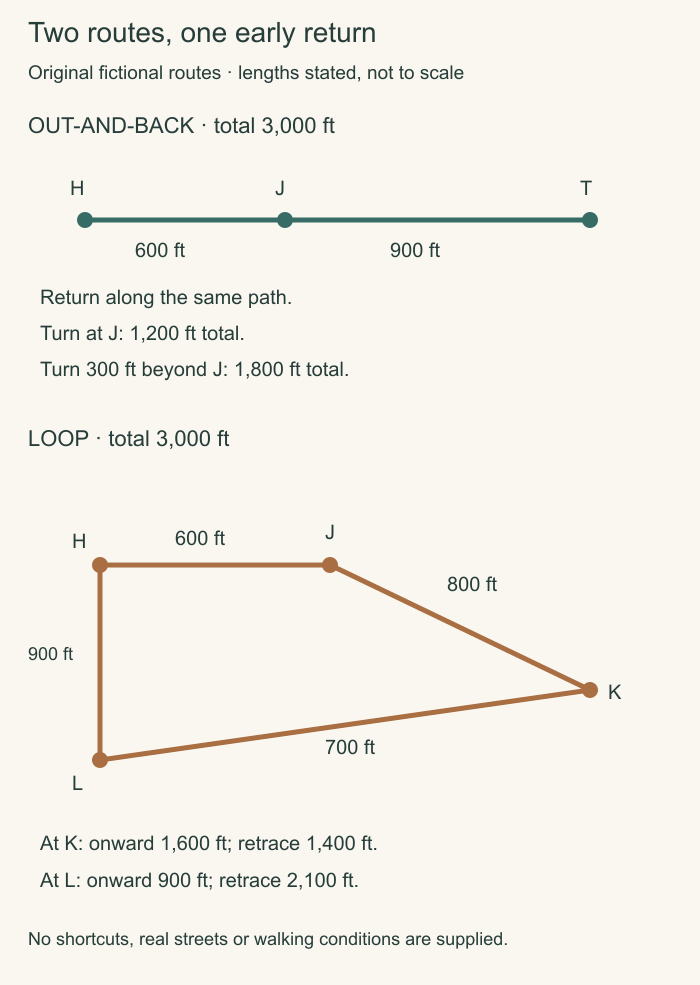
In our sketch, Home is H and the first junction is J, 600 feet away. The out-and-back continues from J to a turnaround T, another 900 feet away, then returns along the same two segments. Its complete length is 600 + 900 + 900 + 600 = 3,000 feet. T is a chosen endpoint, not an attraction that must be reached for the walk to count.
The loop also begins H to J. It then follows J to K for 800 feet, K to L for 700 feet and L to H for 900 feet. Its complete length is also 3,000 feet. The routes therefore offer the same planned distance while arranging the return differently. The letters identify fictional points; they supply no claim about pavement, crossings, slope, opening hours or suitability for a particular walker.
Make the first decision at J
At J, either route can become a 1,200-foot outing simply by returning along the first 600 feet. That is the shared early-return choice. If the purpose is a short conversation outdoors and that has already happened, there is no need to continue just to earn the name of the longer route.
Continuing along the out-and-back adds distance gradually. Suppose you turn around 300 feet beyond J instead of reaching T. You have walked 900 feet from H and have the same 900 feet to retrace, making 1,800 feet altogether. In this deliberately simple model, every additional outward foot also adds a return foot. That relationship makes a shorter version easy to describe before leaving.
Notice what changes after the loop turns
On the loop, reaching K means you have walked 1,400 feet. The onward route through L is another 1,600 feet, whereas retracing to H is 1,400 feet. Continuing would complete 3,000 feet; reversing would produce 2,800. Reaching a point on a loop does not automatically mean that continuing is the shorter way home.
At L, the calculation reverses. You have walked 2,100 feet; the stated final segment home is 900 feet. Retracing the whole approach would mean another 2,100 feet. These comparisons explain why an early decision at J can be more useful than a vague promise to shorten the walk somewhere later. They do not establish shortcuts between the drawn points: none have been included.
Choose the kind of return you want
Choose the out-and-back if you want to vary the turnaround without inventing a new route. Choose the loop if seeing different segments matters more and its stated return options suit the plan. In either case, keep the smaller H–J–H version available from the outset. A companion can understand that agreement more easily than an unspecified invitation to keep going until someone becomes tired.
For an actual neighborhood outing, replace every invented segment with a checked walking route and assess the conditions and needs that this drawing leaves out. The useful part to carry across is the distance question: from the next decision point, what does going on require, and what does returning require? A complete shape on a screen is only one possible answer.
Sources & further reading
Published sources for the details and examples discussed in this story.