A first circuit through a historic neighborhood often gives the surviving buildings most of the attention. Their fronts offer something definite to look at: a tower, a doorway, a roofline. A return can unsettle that easy agreement between visible fabric and history. In Philadelphia's Germantown, the adopted historic-district account describes Market Square through structures that changed use or disappeared. The ordinary shared space becomes more interesting when its openness is not mistaken for an absence of past activity. This is a source-based reading and an imagined return, not a walk we made.
First look: the frontage appears to hold the story
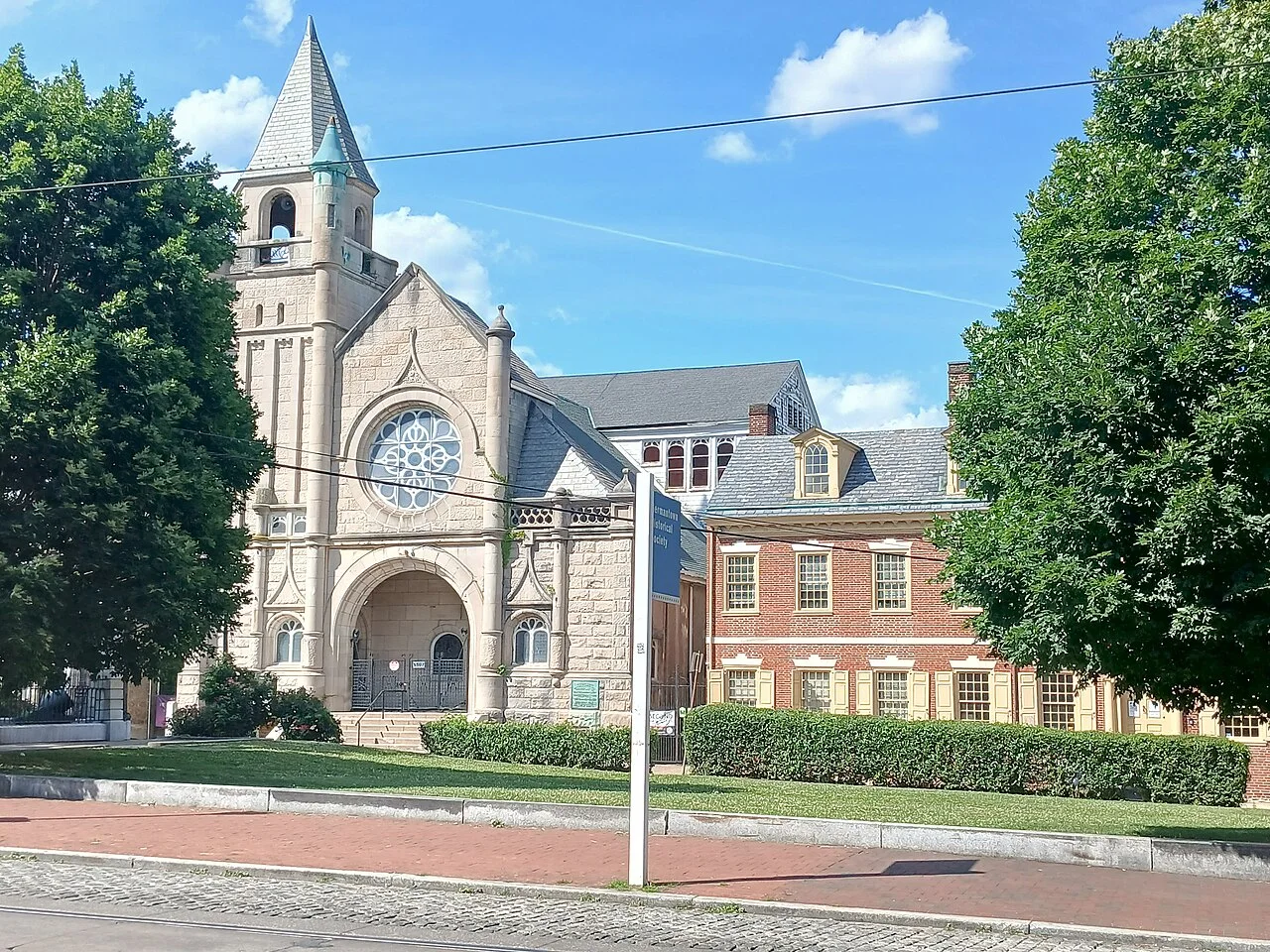
Imagine an initial visitor looking mainly toward the buildings around a common space. The most substantial facade seems the obvious place to begin. An open area can register chiefly as the foreground from which to see it. That is a hypothetical looking habit, not an observation of how Germantown's visitors actually behave.
For the second visit, reverse that attention. Keep the surrounding fronts as the edges of the scene, but read the common itself as a place that once contained working structures. The difference is not adding another landmark. It is allowing the apparently open interval in the first view to acquire a history of its own.
A common could contain regulation as well as gathering
The district document says the Burgesses ordered a prison house, stocks and an animal pound on the newly acquired common in 1703–04. Those are specific functions, not merely a list of occasions when people assembled. The same shared ground could include institutions for confinement and the management of straying animals.
That complicates a picturesque reading of the word common. I would not approach it only as an old version of a pleasant open gathering place. In this account, the space also held the physical means of imposing civic order. The point is not to stage an imagined punishment or claim to know a particular prisoner's experience. It is to notice what a view centered on attractive surviving facades leaves unavailable.
The market shed supplies a different kind of change
The document records a 1740 survey in preparation for a market house. It places construction at about 1741 through local tradition, explicitly noting the lack of a construction record, and separately cites advertisements from 1745. It later describes the shed's reuse for hay scales by 1800 and its demolition in 1850. The account therefore contains different levels of evidence as well as a sequence of uses.
For the imagined return, I would keep the market shed as a changing object rather than draw a confident reconstruction from those few facts. A building could outlast its main trading purpose, take another job and then disappear. Looking at a shared space after that history is different from searching for a surviving building to photograph. Its apparent simplicity need not mean that the earlier place was simple.
Let the return distinguish visible fabric from interpretation
The first visitor's proposed picture holds a facade and an open foreground. The return's picture holds a question about missing occupation: confinement, a market structure and a reused shed within the common. These do not need to be presented as simultaneous activities or pinned to modern positions we have not verified. The historical sequence matters more than producing an invented scene crowded with period details.
If choosing an actual guided visit or a local-history publication, I would ask how it distinguishes surviving fabric, documented former structures and reconstruction. A promise to explain the square is different from a promise that a visitor can still see each object in the story. This feature certifies no current route, entry or archaeological remains. Its reason to return is the shift from admiring what stands around a shared space to understanding how that space could carry work that the present view no longer makes visible.
Sources & further reading
Published sources for the details and examples discussed in this story.