Suppose you have already sent a close-up of a loop on a knitted garment, and the maker replies, 'Could you show us where this is?' Another enlarged crop may repeat the problem. The missing information is the relationship between the detail and the garment. This invented follow-up uses a locating view and a close view labeled A. It supplies that relationship without diagnosing the feature, claiming a repair result or inventing a real exchange with a maker.
Give the detail an address within the garment
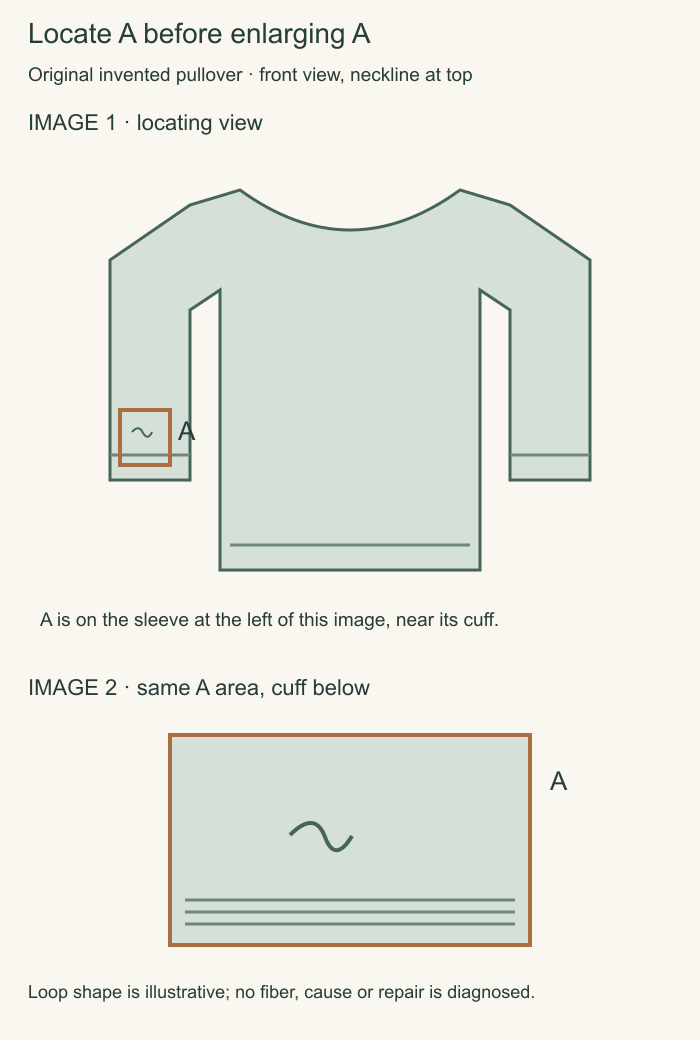
Our original drawing shows a fictional pullover laid flat, front facing up, with the neckline at the top. The feature is on the sleeve appearing on the left of this image, near the cuff. A box marked A identifies the area; the close view carries the same letter. Calling it 'the left sleeve' alone could mean the wearer's left or the left side of the photograph, so the message uses the image position explicitly.
The wide view includes the full sleeve, cuff and body. It is not a second attempt to make the loop look larger. Its job is to let the recipient locate the small box before looking at the detail. Keep the orientation consistent between the two views. If you rotate a close-up for convenience, say so instead of expecting the maker to infer which edge belongs to the cuff.
Describe the visible feature without changing it
For this fictional example, the close view contains a single projecting loop shape. The illustration does not establish a fiber, cause, broken yarn or repair method. A real photograph might reveal less than the drawing does; if the camera cannot show the feature clearly, say that rather than add a convincing-looking line or digitally sharpen it into evidence.
Woolmark defines pilling as fuzzy balls on the surface of wool clothing. That limited definition does not turn every loop into pilling, or identify the material of an unknown garment. Here, 'one projecting loop' is an observation in our staged example. We are not attributing a diagnosis or a definition of snag damage to the pilling page. Neither view calls for cutting, pulling or shaving the area.
Send a complete follow-up, not just two attachments
An original message could read: 'Thank you. Image 1 shows the front of the pullover laid flat, neckline at the top. Box A is on the sleeve shown at the left of that image, near the cuff. Image 2 is a closer view of the same A area with the cuff still below it. I can see one projecting loop. I have not attempted a repair. Does this locate the area clearly, or do you need another view before advising?'
Replace every detail with what is true for your garment and photographs. Do not borrow the fictional claim about an unattempted repair if something has already been done. If there is an earlier order or product reference in the existing conversation, keep that connection visible without putting private account information into a public image. The follow-up should make the next assessment easier, not create a false history.
Keep the two jobs separate
The locating view answers where; the detail view answers what is visible. If the maker asks for the inside surface or a label next, those are new requests rather than evidence that the first two images failed. The useful outcome of this pair is a mutually identifiable area. Whether it can be assessed remotely, and what should happen next, remains a separate question for the provider.
Sources & further reading
Published sources for the details and examples discussed in this story.