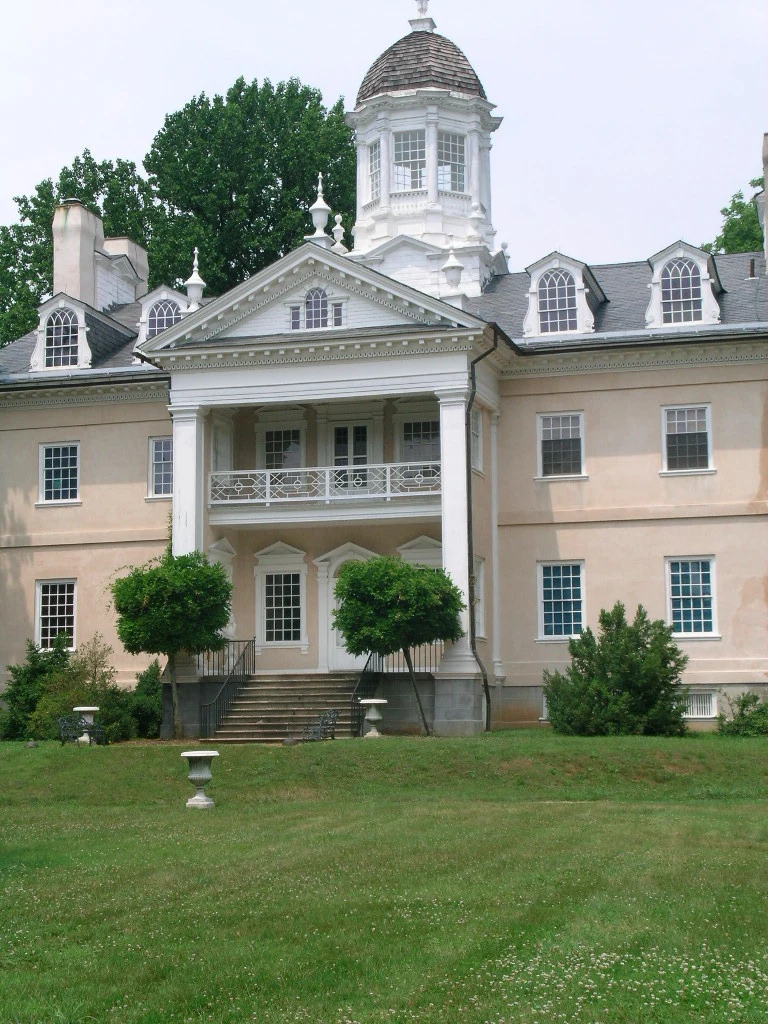
A museum sofa has more than one date in its story. The Hampton National Historic Site record for John Finlay’s sofa, catalog number HAMP 1160, brings an 1832 order together with a later reproduction of its crimson silk damask. Reading those details together gives a visitor something more precise to notice than whether the room simply looks old. This account follows the museum’s documentation rather than a personal visit.
The order names a particular piece
According to the National Park Service’s object record, John and Eliza Ridgely were billed in October 1832 for seventeen pieces of painted and gilt furniture intended for Hampton’s Drawing Room. The sofa belonged to that commission. Its entry described gilt swans and animal-like legs, while excluding damask from the covering supplied in that line of the bill.
The record connects those descriptions to the carved swan arm supports and gilded lion’s-paw feet. They are useful anchors for reading the documented design: a named maker, a particular commission and specific forms. An unfamiliar word in an old account becomes easier to follow when the museum explains which part of the object it describes.
The covering adds another chapter
The same record says the original crimson silk damask upholstery fabric has been reproduced. That makes the present covering part of the explanation, rather than a detail to pass over. Its appearance can help convey the intended furnished effect while its material history differs from that of an untouched textile surviving from the commission.
The bill’s exclusion of damask does not establish that the sofa was intended to remain uncovered. It describes the scope of that recorded charge. The museum’s statement about reproduced upholstery answers a different question: how the covering associated with the object is represented now. Keeping the two statements separate avoids turning a purchase entry into a complete manufacturing history.
Take two questions into the room
For a visit, carry this pair of questions: which documented features belong to the commissioned design, and which visible surfaces have a later history? Here the museum supplies specific starting points—the swan supports, the paw feet and the reproduced damask. Its broader decorative-arts account places the Finlay furniture within the Drawing Room collection.
The record cannot identify the age of every component from a room photograph. It can, however, change the way the sofa is encountered. A surface need not be the oldest surviving material to carry historical information, and a dated bill need not describe everything seen on the object today.
Sources & further reading
Published sources for the details and examples discussed in this story.