The sweater fits the wardrobe when it is worn; the harder question is where its folded shape will go. A narrow pile can look efficient while leaving an awkward overhang, and a broad fold can use less height while occupying the whole shelf. Start with the garment's actual instructions. Woolmark distinguishes gently folded knitted garments stored in drawers from woven garments supported on shaped or padded hangers. That is a construction distinction, not a reason to hang every item carrying a wool label.
Make a dry-storage comparison, not a reshaping exercise
This comparison starts with a clean, dry garment ready to put away. It does not describe drying a wet sweater or pulling one into a new size. The folded dimensions below are invented planning measurements. They are not Woolmark's recommended fold, a measurement of a named sweater, or a prediction that every knit tolerates the same arrangement.
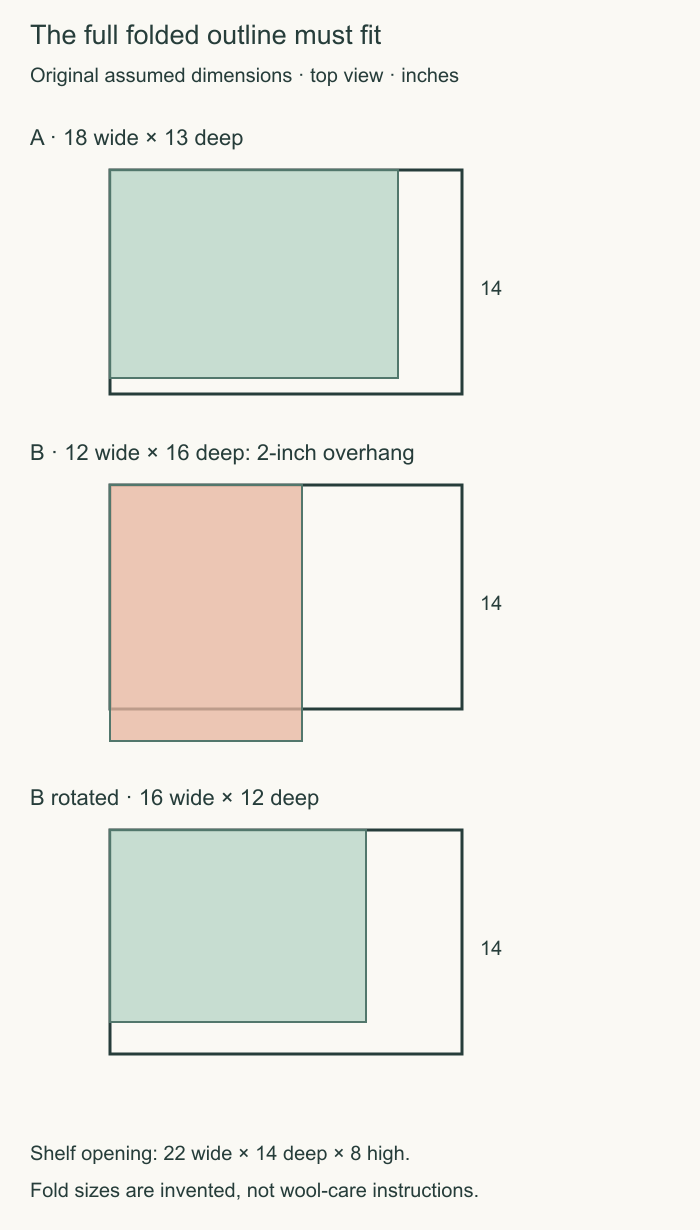
Imagine a shelf opening 22 inches wide, 14 inches deep and 8 inches high. Leave the actual shelf edges visible while comparing positions; measuring the board alone can conceal a lip or a door that reduces the usable opening. Our example assumes the stated opening is already usable. Whether the particular garment belongs there still depends on its own care information and the storage conditions.
A broad layer keeps the whole fold supported
For arrangement A, assume the dry sweater has been gently folded into an 18-by-13-inch rectangle, 2 inches high. Place its 18-inch side across the 22-inch shelf. The nominal remaining width is 4 inches, and the remaining depth is 1 inch. Nothing in those numbers authorizes compressing the fabric; they simply show that this assumed rectangle stays within the shelf boundary.
At that assumed thickness, three identical layers would total 6 inches, leaving 2 inches above them. That is a geometric comparison, not a recommendation to build a three-sweater pile. Retrieving the bottom sweater would disturb two others. A reader who wears that one most often could choose a single layer or put it on top rather than treating every remaining inch as space to fill.
A narrow stack can fail in the other direction
For arrangement B, rotate an assumed 12-by-16-inch fold so its 12-inch side runs across the shelf. Its 16-inch depth now exceeds the opening by 2 inches. The narrower face has not solved the storage problem. Turning it through a quarter turn gives a 16-inch width and 12-inch depth, which fits the example opening without that overhang.
The useful comparison is therefore A versus the rotated B, not a neat photograph versus a messy one. Rotated B leaves more spare width and more spare depth than A. Neither result tells us that an extra fold is good for this sweater. Try a gentle arrangement consistent with its care information and measure its actual relaxed outline instead of forcing the assumed rectangle.
Choose the arrangement you can retrieve
If a drawer is available, Woolmark's folded-knit guidance provides the more direct storage example. The shelf drawing here only demonstrates how to compare an opening and two assumed outlines; it does not attribute shelf approval to Woolmark. A different shelf, lining or garment may change the practical choice.
Before buying another organizer, put a paper rectangle at the intended position and mimic the movement of lifting it out. A container that fits only after the entire pile is removed may add a task rather than solve one. Keep the garment's care information with the decision and change the layout when its real dimensions differ from these examples.
Sources & further reading
Published sources for the details and examples discussed in this story.