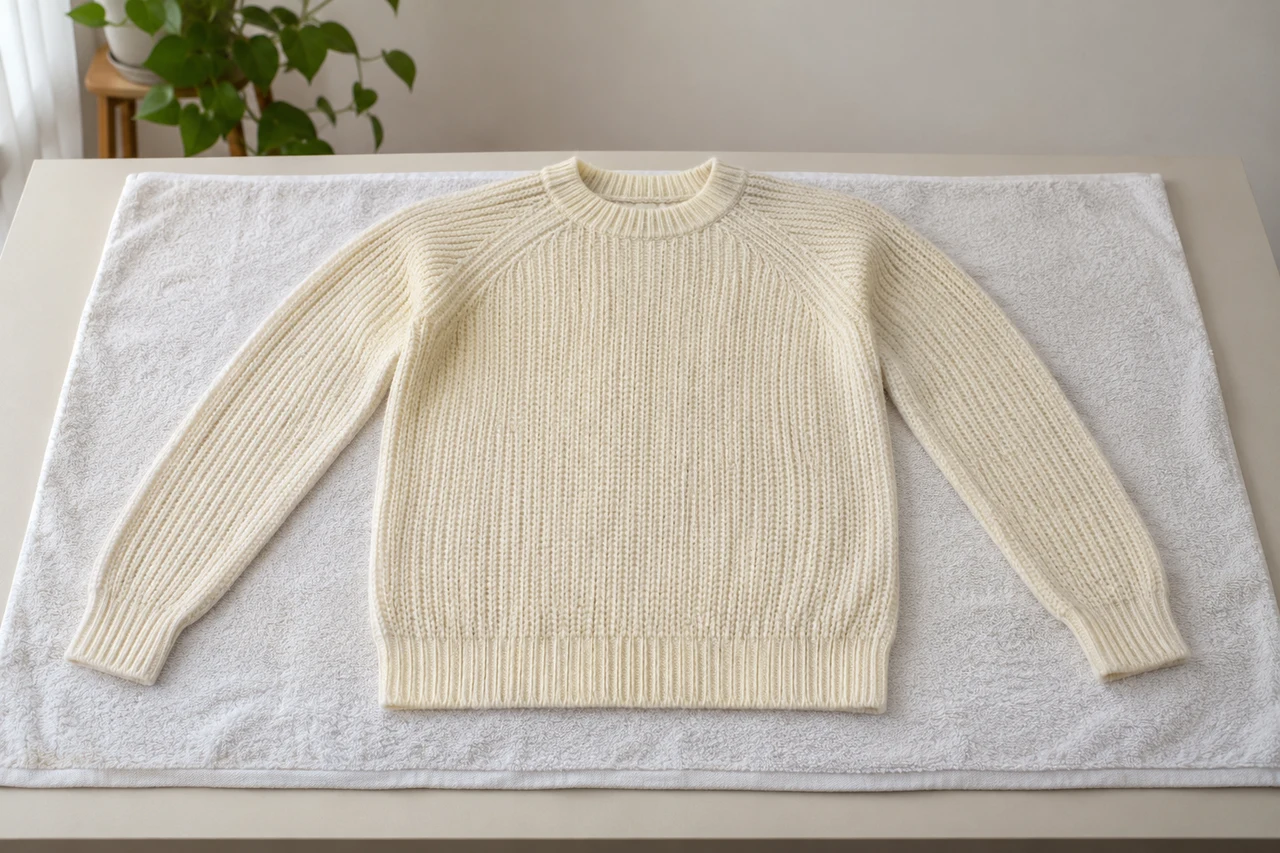
Flat drying needs a place where the body and sleeves can stay supported while the garment dries. That is a different task from finding a shelf for a dry folded sweater. Woolmark recommends flat drying washed wool garments, particularly knitwear, unless their care claim permits tumble drying. Begin with the actual garment’s complete label: this guide plans a supported drying place and supplies no permission to wash an item that needs another form of care.
Read the method before clearing the space
Check what the actual item says about washing and drying, including any additional wording about trims or construction. Resolve a conflict or uncertainty with the maker before proceeding. A general wool guide does not make every wool-containing coat, embellished knit or lined garment suitable for the same handling.
For this proposed workflow, assume the particular knit has been washed by its permitted method and its directions allow flat drying. No washing temperature, detergent, spin setting or excess-water removal technique is supplied here. Keep those item-specific steps separate rather than filling a gap with a familiar method from another sweater.
Prepare support for the whole outline
Woolmark recommends a pale-colored or white lint-free towel for flat drying. Set up a suitable clean supporting place with room for the garment’s relaxed outline, including the sleeves. This is a planning check, not a measured claim that a particular table or towel has passed a color-transfer or moisture-resistance test. Protect the supporting surface appropriately for its actual material.
Place the knit so the body and sleeves remain supported rather than hanging over an edge. Woolmark explains that hanging wet knitwear can stretch it under the weight of its moisture. A small drying space that leaves half the garment suspended has not solved that problem simply because its center rests flat.
Settle the intended shape gently
Woolmark describes gently bringing the garment into shape and removing folds or creases when placing it on the towel. Preserve the item’s intended outline, including any deliberate asymmetry, without pulling it into a new size. A sleeve tucked under the body can be moved into a supported position rather than left as a thick folded bundle.
This is ordinary positioning during drying, not a method for reversing shrinkage or changing fit. If the garment has already changed substantially, ask the maker an item-specific question. A generic instruction to reshape does not establish how much force a particular fabric tolerates or whether a previous change can be repaired.
Choose the position without adding heat
Let the garment dry naturally in the air as Woolmark directs, away from direct sunlight and direct heat. Its guidance specifically cautions against drying over a radiator. Keep that boundary when choosing the place rather than moving the knit toward a heater to meet an assumed timetable. No drying duration is promised here.
Keep the drying task separate from putting the garment away. This workflow establishes no measured moisture threshold or storage approval. Follow the actual item’s care requirements when it is ready for storage, and do not stack another garment over it merely to free the surface while drying continues.
Before purchasing a specialty drying screen, check whether an appropriate existing flat arrangement can support the complete knit. If considering a screen, investigate its actual support area, stability and placement requirements. A product described as compact may still be too small for the garment you need to lay out.
Sources & further reading
Published sources for the details and examples discussed in this story.