One yard answers a length question. It does not say that a fabric is one yard wide, or that every square inch in the purchased rectangle can enter a project. Mood’s Royal Purple Cotton Voile, item MD1325, provides a useful published example: its listing sells by the yard and gives a width of 55 inches. The worked layout below is original and hypothetical; the fabric has not been measured or cut for this article.
Give the two directions different names
In a one-yard example, the ordered length is 36 inches along the fabric. The seller’s listed 55-inch width runs across it. Multiplying those figures gives a nominal rectangle of 1,980 square inches. Buying two yards would extend the length to 72 inches; it would not turn the roll into a 72-inch-wide fabric.
That distinction matters before opening a project calculator. Write the order as “36 inches of length across the listed 55-inch width,” then mark which direction the pattern or cutting plan needs. A square-looking product image does not supply either of those measurements, and a price per yard is not a price for a square yard of this particular cloth.
The listed width includes the edges
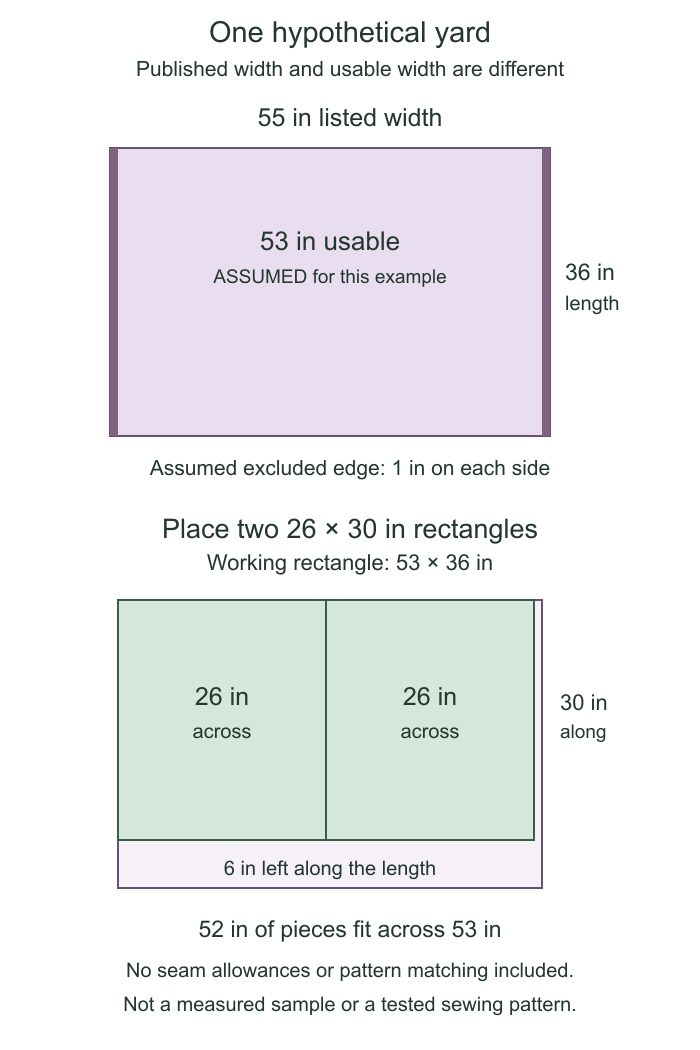
Mood explains that its fabric width is measured from outer edge to outer edge, including selvages, and can therefore be wider than the usable width. The 55-inch listing does not establish how much of this particular piece a project can use after accounting for its edges.
For the drawing, assume that the usable width is 53 inches: one inch is set aside at each edge. That is an invented allowance for the example, not a measurement of MD1325 or a rule for all fabrics. Under that assumption, the working rectangle is 53 by 36 inches, or 1,908 square inches. The diagram labels both the published width and the hypothetical reduction so they cannot quietly trade places.
Area alone cannot arrange the pieces
Suppose an imaginary project needs two rectangles, each 26 by 30 inches, with no further allowances. Put their 26-inch sides across the assumed usable width. Together they occupy 52 inches across and 30 inches along the purchased length. That arrangement fits inside 53 by 36, leaving one inch across and six inches along.
Now require both rectangles to turn through a quarter turn. Two 30-inch widths need 60 inches across, which exceeds 53. Stacking their 26-inch lengths requires 52 inches along, which exceeds 36. Their combined area remains 1,560 square inches in either orientation, yet this rotated arrangement does not fit. The spare area is not all in the places the pieces need.
These are geometric rectangles, not a tested sewing pattern. A real project may restrict orientation, require seam or hem allowances, need pattern matching, or use a different layout altogether. Add those requirements to the actual pieces before judging the order length. The arithmetic cannot supply an allowance that the drawing has left out.
Turn the calculation into an order question
The useful next step is to state the missing quantity precisely. For this example it is the usable cutting width of the selected cloth, rather than another guess at its total area. The named item and its published width identify what to ask about; the project’s own cutting dimensions determine why the answer matters.
Keep the layout separate from any preparation that could change the cloth’s dimensions. Mood’s page gives general cotton-care guidance, explicitly qualifies that guidance and calls for testing a swatch. No shrinkage percentage or finished yield is established here. If the project depends on a tight fit, resolve its preparation and cutting requirements before treating the nominal rectangle as a purchasing guarantee.
Sources & further reading
Published sources for the details and examples discussed in this story.