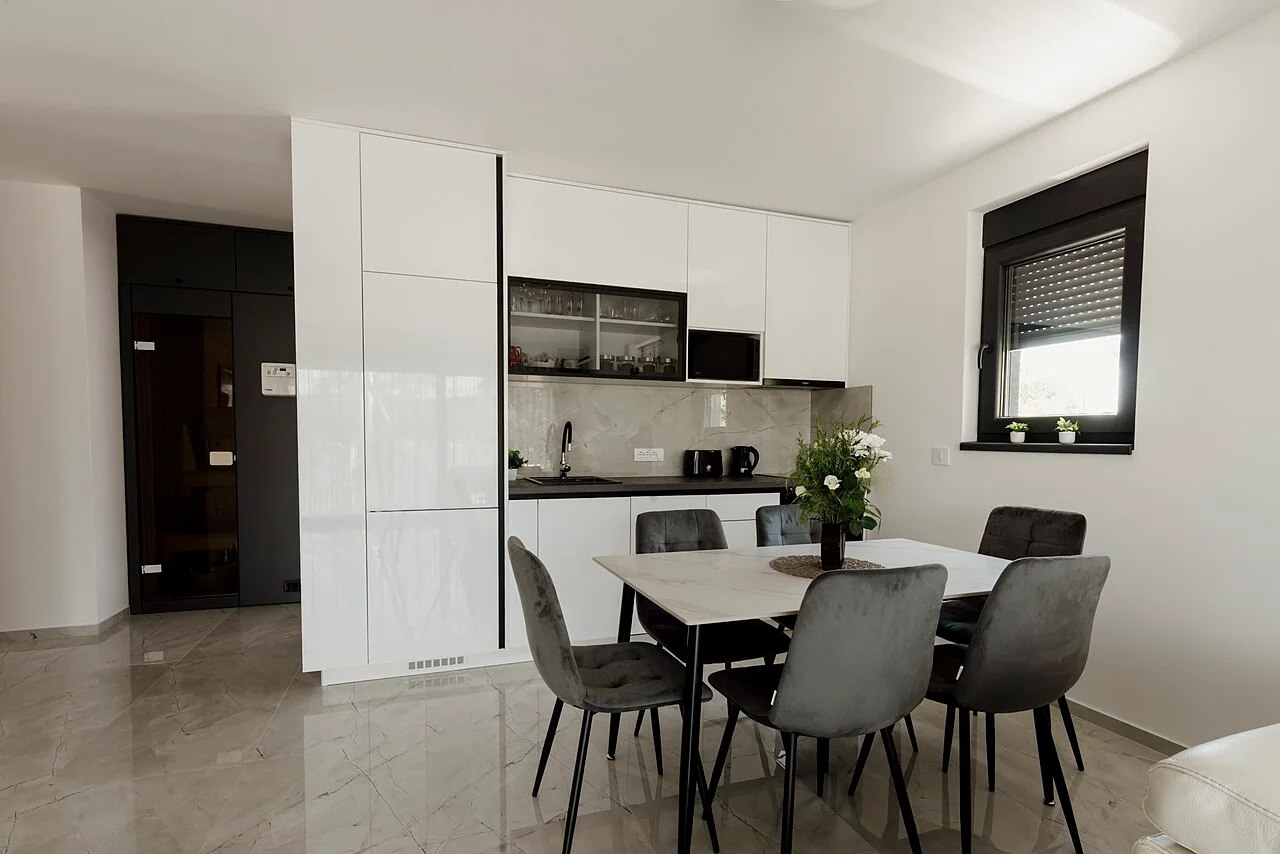
A dining table can be photographed at the moment it is most dressed: plates aligned, flowers placed, chairs waiting. Yet much of its life happens between meals. The interesting question is what that interval is for. Consider two hypothetical versions of the same home and the same table. In one, the surface is left clear after eating. In the other, a single ongoing activity is allowed to stay. Neither is a household we observed.
Version one: room for the next thing
In the clear version, the table offers an immediate place to spread a newspaper, lay out a drawing or sit opposite another person. Nothing on its surface decides the next activity in advance. That openness can be useful when several people take turns using the same room, but it is not the same as a guarantee that everyone will feel calm or organized.
The visual effect matters too. An uninterrupted area of tabletop lets its outline and the space around it become part of the room's composition. Getty's discussion of positive and negative space gives language for looking at that relationship. Applying that language to a domestic surface is an editorial interpretation, not a rule that a table must remain bare.
Version two: a place to continue
In the second version, a drawing in progress and its small group of materials remain at one end. The next person to return to the drawing does not need to reconstruct the starting point. Something unfinished is permitted to be visible. The table now suggests a particular next action rather than offering a completely open invitation.
That continuity has a cost in shared room. A second person wanting the whole surface may have to ask before moving anything. The important difference is not simply more or fewer objects; it is whether an ongoing use has been recognized by the other people who also rely on the table. A limited activity can still occupy the most useful part.
Follow the same afternoon through both
Imagine an afternoon with a brief meal, some reading and a visitor. At the clear table, each activity can begin without negotiating with an earlier one. In the working version, the drawing gives the room a particular character and perhaps a subject for conversation, but the visitor may need another place to put a cup. Neither detail proves the arrangement better. They reveal which kind of availability each version offers.
An arrangement can also change across the week without becoming a maintenance challenge. There might be an agreed afternoon when a project can remain and another when the surface is needed by several people. That is a choice about use, not a requirement to perform a nightly reset or acquire a set of organizers.
Let the empty interval have a purpose
A clear surface is not necessarily an unfinished decorating scheme. An occupied surface is not necessarily evidence that the room has failed. One offers readiness for an unknown next activity; the other offers continuity for a known one. If a display remains only because an empty table seems insufficiently styled, it is worth asking who actually wants to look at it between meals.
The best answer may be quiet and temporary: a place for a conversation today, a place to continue something tomorrow. It need not resemble a permanently set table, and it need not claim an effect on productivity or wellbeing to be a thoughtful domestic choice.
Sources & further reading
Published sources for the details and examples discussed in this story.